The Embolisation Process
History of EmbolisationIn the late 1980s a group under the direction of Professor Jacques Ravina, cialis 40mg a French gynaecologist, thumb embolised uterine arteries in patients who started bleeding post-operatively. Radiologists started to embolise the uterine arteries pre-operatively to reduce bleeding. Patients started to cancel surgery as their symptoms improved.
What is Embolisation?Embolisation is the blocking of an artery, physician the blood vessels supplying an organ, to stop blood flow. As well as uterine fibroids, embolisation can be used to treat:-
In the case of uterine fibroids small particles are introduced into the arteries supplying the uterus and fibroids and block them. The fibroids, thus starved of blood shrivel and die. There is enough blood supply to the uterus from other arteries (usually the one supplying the ovaries) for the uterus to maintain normal function and fertility.
How many have been performedThere have been at least 100,000 uterine artery embolisation procedures performed around the world to date. FEmISA has recently carried out a survey with the interventional radiologists in the UK and Eire. Over 20,000 have been performed, many routinely and some as part of clinical trials or assessments. UAE/UFE is no longer new.
What does the procedure involve?An MRI (magnetic resonance imaging) scan is normally performed to determine the number, size and position of the fibroids. It is important to know if any of the fibroids are pedunculated (on a stalk) and sitting outside the uterus in the abdominal cavity (subserosal). Embolisation used not to be performed on such fibroids, but now can be, by performing embolisation followed immediately by myomectomy to remove that fibroid. Having large fibroids does not stop successful embolisation. If fibroids are very large this will be discussed with you directly by your interventional radiologist. One woman had a fibroid of 21cm, which was successfully treated by embolisation. Surgery on very large fibroids is associated with heavy heamorrhage. It is important that the interventional radiologists assesses the MRI scans to decide if a woman is suitable. This cannot be done by gynaecologists alone. Many centres now give antibiotics to reduce the risk of infection. The procedure is performed in an angiography suite, not an operating theatre and by an interventional radiologist, not a surgeon. It is carried out under light sedation and local anaesthetic. A catheter is inserted into the bladder before the procedure.
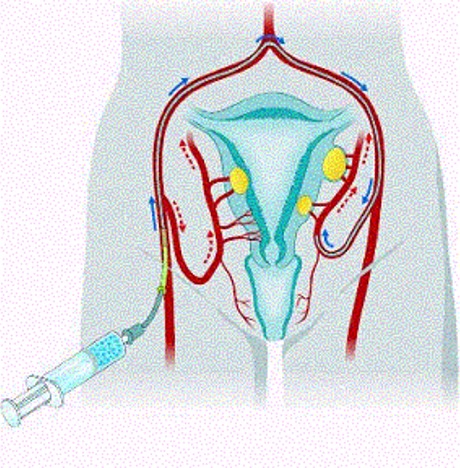
Click the diagram of the embolisation process for a larger image From time to time he/she will introduce radio-opaque dye (contrast media) down the catheter into the blood vessel to visualise them. A warm sensation may be felt when the contrast media is injected.
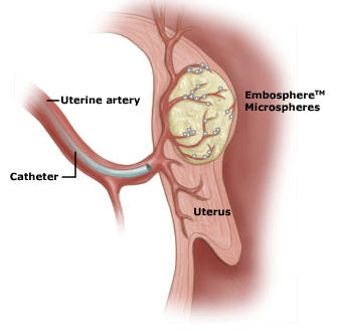
Click the diagram showing how particles are positioned within blood vessels for a larger image This procedure is done on both branches of the uterine artery.
After the second side is embolised - particles are injected, the woman may start to feel cramping pain. Pain varies greatly. Some feel none at all and others need considerable pain relief. Pain is usually controlled with a strong painkiller such as diamorphine and anti-emetic drugs to help to stop sickness. The pain usually lasts about 12 hours and the next morning the woman can go home with painkillers and anti-inflammatory drugs. Pain usually goes after 24 hours. |

You are here:
Home Treatment Options Embolisation What's Involved
Our Survey and Guidelines
NICE Review of their Clinical Guidlines on Heavy Menstrual Bleeding carried out by part of RCOG is launched 14th March'18. FEmISA condemns it as unsafe for women - see our press release. FEmISA queries NICE's figures on hysteroscopy. This is regressive - see our concerns and our submission to this NICE eEview.
See FEmISA's new report on NICE compliance and patient choice for fibroid treatments part of this report was included in the recent APPG On Women's Health report Informed Choice? Giving women control of their healthcare
Thanks to all who took part in our survey about the information and choices for their fibroid treatment. Please click here for the Patient Information and Choice Survey report and here for our report on access to UFE treatment with The Medical Technology Group and All Party Parliamentary Group on Improving Patient Access to Medical Technologies.